Wearable data + labs. One health picture.
Bring the pieces of your health together.
Longevity-focused analysis, without the clinic. Start with the data you already have — wearable numbers, lab results, or both. The Longevity Lab brings them into one clear view, shows what matters most, and helps you build your Longevity Protocol.
- 1Free Baseline Audit — shows what your numbers reveal.Free
- 2Focused protocols — for the health areas that matter to you.Membership
- 3Master Synthesis — the relevant findings in one priority plan for your year.Membership
Free, no card required.
About five minutes to enter your numbers. No device connection required.
Type in or paste wearable numbers, or bring in your recent lab results.
Free Baseline Audit · Wearable only
Already have bloodwork?
Your labs can show a part of the picture your wearable can't.
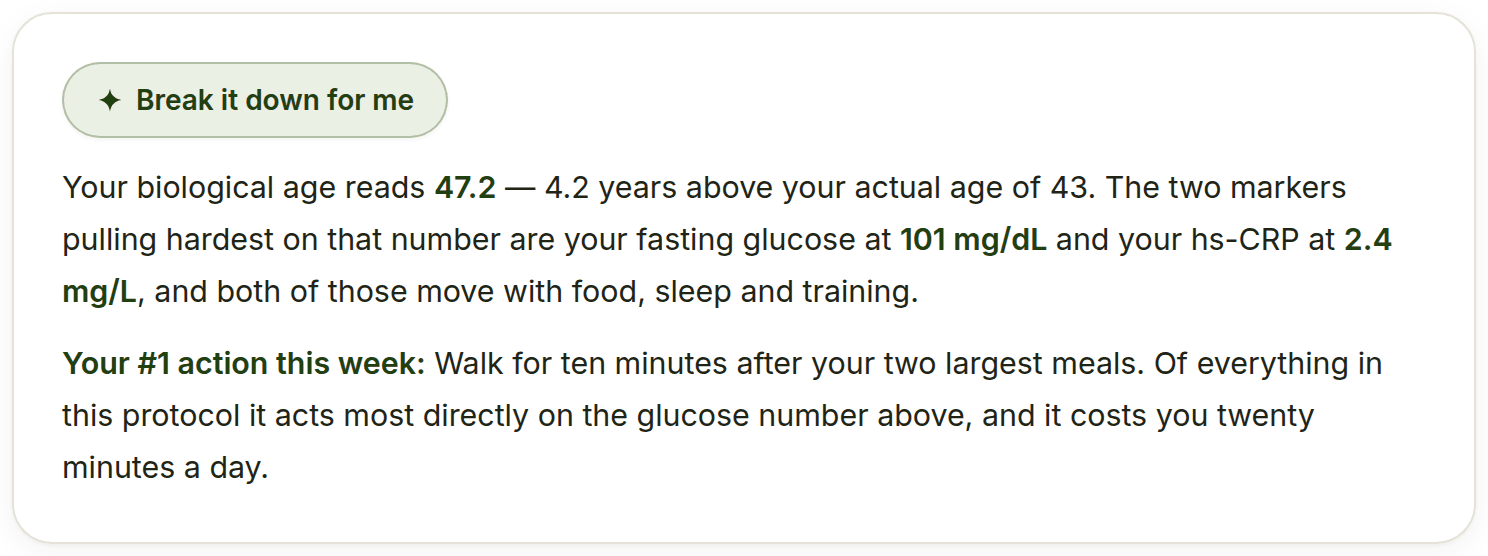
If your recent labs include the required markers, The Longevity Lab can calculate your biological age using PhenoAge, a published method based on standard blood markers. Your Master Synthesis also names the markers driving that result.
Wearables show the day-to-day pattern. Labs add metabolic, cardiovascular and biological-aging context. The Lab brings both together.
Who the Lab is built for.
- Your recovery and sleep numbers have been drifting for months, and you're not sure why.
- You're in perimenopause, and your sleep, temperature and HRV stopped behaving the way they used to.
- You train hard, recover badly, and nobody has told you which of the two to fix.
- You have four apps, plenty of numbers, and no clear place to start.
- Nothing is wrong yet, and you would like to keep it that way.
Real output
This is what the Lab actually gives you.
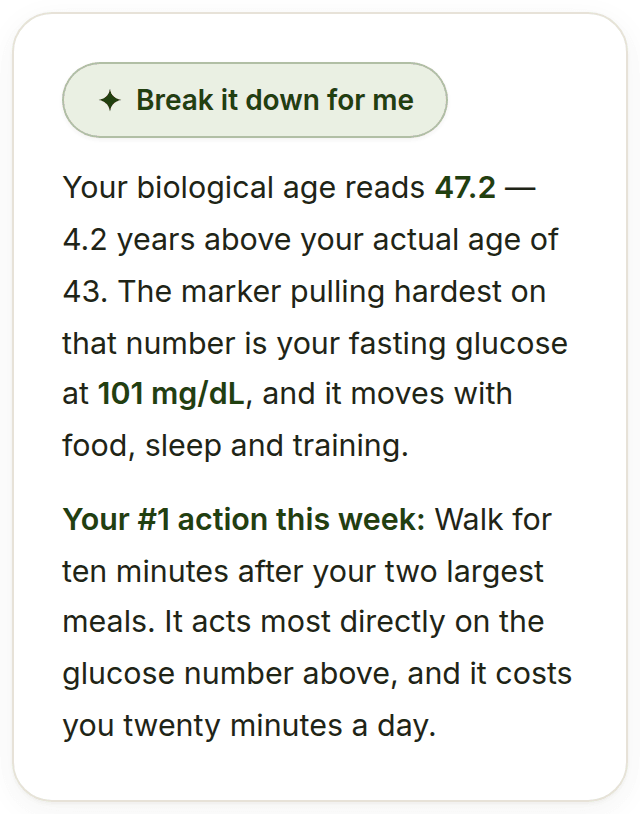
What the Lab produces, and what using it looks like. The first is a real member’s output after adding bloodwork, including the biological age only labs can calculate. The second is the wearable-only path.
What it does: takes the findings that matter across your areas and puts them in one order — what to work on now, what can wait.
Layer 1: Executive Summary
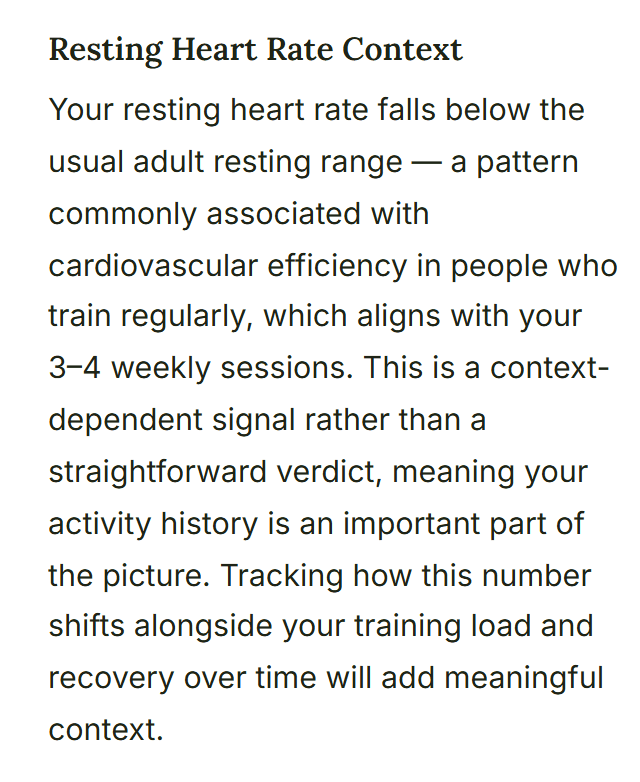
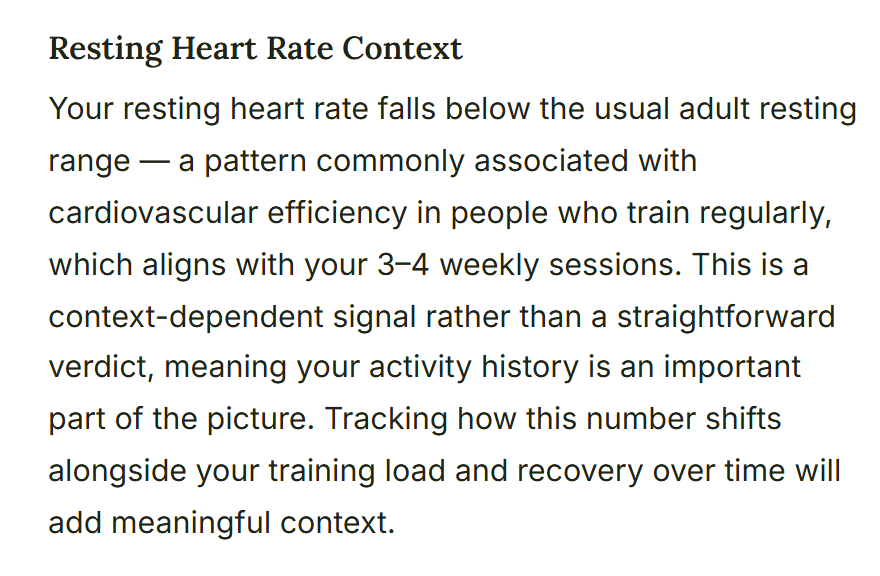
What it does: reads what your wearable can measure, and says out loud how much of the picture it is working from.
Inside the Lab
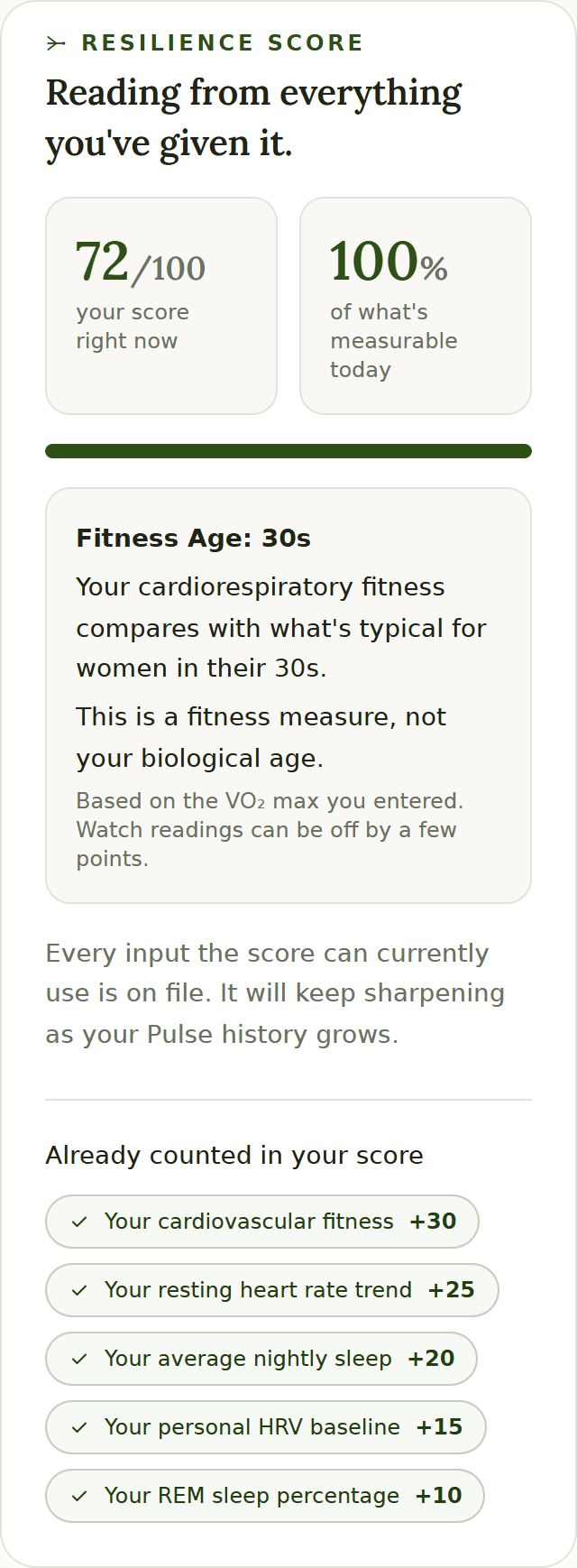
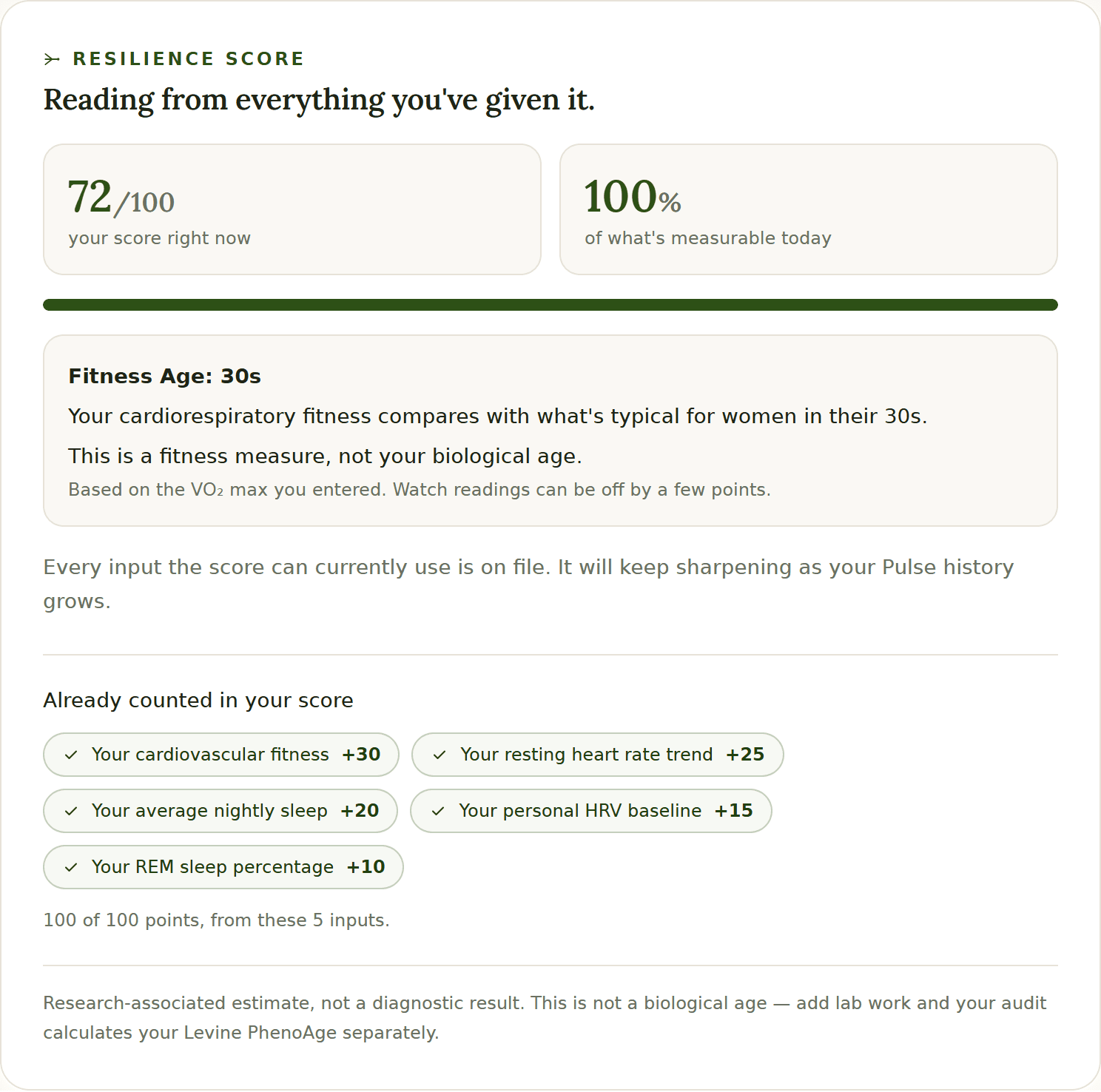
Fitness Age is a lookup against an age- and sex-matched reference table — a fitness measure, not a biological age.
Real output · Real screen
How the Lab works
A plan for each area. Then one order to work in.
Step 1 — Build your baseline.
Start with wearable data, labs, or both. Type in or paste the numbers you already have. If you use a wearable, bring those readings. If you have recent labs, bring those too. The Lab works from what is available and clearly shows what is still missing.
Step 2 — Build your focused protocols.
Work through the health areas that matter for your goals and your data — sleep, training, recovery, nutrition, body composition, hormonal transitions. Each one is a station inside the Lab, and each returns a practical plan of its own.
- Sleep & Circadian
- Training Plan
- Stress & Recovery
- Nutrition
- Supplement Review
- Body Composition
Step 3 — Create your Master Synthesis.
The relevant findings come together into your Longevity Protocol, one sequenced priority plan: what to work on now, and what can wait.
You work through the areas relevant to your data and goals, not all of them. What you see depends on what you have entered and what applies to you.
No noise. No alerts. Focused plans for the areas you're working on, and one Master Synthesis for your first priority.
Entering your numbers takes minutes. Work through the health areas relevant to you at your own pace. Calibrated every two weeks. Checked in every three months.
“My wearable already tells me things.”
It does — and that's a good start. Your wearable is a strong view of your recent sleep, recovery and activity. The Lab adds what sits around it: your bloodwork, your life stage, and what you've changed lately.
Add labs and the picture gets fuller, and bigger. A wearable trend, a lab panel and a training change each point at something different. Bringing them together is the work the Lab does for you.
What your free Baseline Audit shows
Enter the numbers you already have and the audit reads them together rather than app by app. It is a read of where you are now, and a pointer to the area worth looking at first — not the full plan itself.
- The single largest constraint in your system — named, not scored
- Your Resilience Score, and which direction it is actually moving
- Sleep disruption patterns tied to your recovery, not reported separately
- Metabolic and cardiovascular signals read together instead of app by app
- The health area worth looking at first, and why
Your free Baseline Audit starts with whatever data you already have — wearable readings, labs, or both. Wearable data can show sleep, recovery and fitness patterns. Labs can add metabolic, cardiovascular and biological-aging context. Biological age is calculated with membership, and only when the required lab markers are available.
What membership adds
The audit tells you where you stand. Membership is where the plans get built.
- A focused protocol for each health area relevant to you — sleep, training, recovery, nutrition and more
- Master Synthesis — the findings that matter, in your Longevity Protocol, one sequenced priority plan
- Pulse check-ins every two weeks, so the picture keeps up with you
- Re-run any protocol when your training, sleep, recovery or life changes
Dual-engine validation
Every number is calculated or disclosed. Never guessed.
Most AI health tools skip straight to a recommendation. The Lab calculates first — then synthesizes. Every finding is traceable to its source.
Engine 1 — Deterministic clinical layer.
Recovery metrics, lipid ratios, and VO₂max estimates are calculated using published medical formulas, not inferred by an AI. Biological age is the one value that genuinely requires bloodwork — and if labs aren't on file, the system says so plainly rather than guessing.
Engine 2 — Synthesis layer.
The AI only works with verified outputs from Engine 1 plus your wearable and lab inputs. It does not recalculate clinical values. It does not override them. It does not invent missing data. It only synthesizes what is real.
You can trace any number in your protocol back to its source. Always.
The living system
Most longevity products hand you a report. This one answers back.
A plan built in January shouldn't still be guessing in March. So the Lab keeps reading.
Every two weeks, the Pulse. Log three numbers from your wearable — your 14-day average HRV, deep sleep, and resting heart rate. Sixty seconds. The system compares them against your protocol baseline and returns one directive: what's moving the right way, what isn't, and the single thing to focus on next. No bloodwork. No appointment. Just your wrist and a straight answer.
Any time life changes, re-run that area. New training block. Cut sugar. A brutal quarter. Update your training, nutrition, sleep or recovery plan the moment it happens, and that area is re-read against where you are now — not where you were at signup. When enough has moved, run your Master Synthesis again and the priority order is rebuilt around it.
Your Baseline and check-ins stay locked once saved, so your progress line stays honest no matter how often you update.
That's the difference between a report and a system: a report is true on the day it's printed. This one stays true.
It reads the numbers you enter and shows you what they already reveal.
Free, no card required.
About five minutes to enter your numbers. No device connection required.
Or see a real protocol firstSimple, honest pricing
Start free.
Not another score. A protocol you can update, check, and rerun as your body changes. Membership builds your Longevity Protocol from your wearable data, your labs, or both. No kit to buy, no hardware, no annual commitment. Cancel anytime.
Free Baseline Audit
Step 1 — no card required
$0
Start here.
Load your wearable data, your labs, or both. Get findings from your own numbers, and the area worth looking at first — free, no card required.
Takes minutes. See real findings from your own data before you pay anything.
Monthly Trial
Step 2 — when you're ready
$0 today — 7 days free
Then $12.99/month
Cancel anytime.
Full membership access for 7 days, then $12.99/month if you stay. Focused protocols for the areas relevant to you, your Master Synthesis, Pulse check-ins and updates. Cancel anytime.
No annual commitment. Cancel anytime from your account.
Try it before you commit to it.
Run your Baseline Audit for free. Load your wearable data, your labs, or both — no card required.
Like what you see? Start your full membership with the trial. You get full access before the monthly rate begins — cancel anytime before then and you're never charged.
Because the product either replaces your data fatigue, or it doesn't — and you shouldn't have to pay a full month to find out.
While you decide, the Lab isn't idle: log a bi-weekly Pulse check-in from your wearable, or re-run any station once real time has passed — about two weeks is enough to see a genuine signal instead of noise. Neither ever resets your check-in dates, so there's no risk in exploring in between.
What does my $12.99/month get me?
How does my data get in?
Do I need recent lab work to use The Longevity Lab?
What if my wearable isn't listed?
Do I have to wait a year to get anything useful?
What is the bi-weekly Pulse?
Can I re-run a station or check my Pulse more than once?
I'm in my 40s — is it too early to start?
Is this built for women, or for men?
Is this medical advice?
Who sees my health data?
From the Lab
What your data actually means.
Sourced, evidence-based writing on wearables, bloodwork, HRV, and healthy aging after 40 — free to read, no account needed.

Wearables & Labs
How to Combine Oura Ring Data With Blood Work
Oura shows daily recovery patterns. Blood work adds biological context. The useful layer is knowing how to read both without overreacting.
August 18, 2026 · 3 min read

Wearables & Labs
Function Health vs Longevity Lab: What Happens After the Labs
Function Health makes broad blood testing easier to access. The Longevity Lab starts with wearable trends and turns them into a Longevity Protocol.
August 18, 2026 · 3 min read

Training & Strength
Why VO2 Max Predicts How Long You'll Live Better Than Almost Any Other Number
VO2 max isn't just an athletic stat. It's linked to all-cause mortality more strongly than most standard risk factors, and it's trainable at any age.
August 9, 2026 · 5 min read
Your body has been sending signals for years. Start reading them as one system.
Run My Free Baseline AuditFree, no card required.
Grounded. Intelligent. Alive.
— The Longevity Lab